
How to Search Peshtigo Property Records
Begin with the address in Ascent. Copy the parcel number it returns. Then check county GIS to confirm whether the municipality is Peshtigo city or Peshtigo town. LandShark holds the recorded transfers, and Ascent carries the tax account. The City of Peshtigo's assessor page posts its own assessment notice. Building-inspection resources supply permit forms and contacts. Near the boundary, the municipal label beats the postal city name every time. County systems answer the parcel, deed, and tax questions. Local sources handle assessment and permits.
- Search Ascent with the site address as a single search key.
- Copy the parcel number and read the municipality or tax district in county GIS.
- Use LandShark for the recorded deed and Ascent for bill and payment details.
- Check the City Assessor page for city-specific assessment notices.
- Request permit records from Peshtigo Building Inspection by address and parcel.
One page answers most of it. The county's Marinette County property search guide explains the shared lookup path, since a Peshtigo records question usually turns on the City versus Town label and the local assessment story.
Where Peshtigo Property Records Are Kept
Marinette County holds the recorded deeds, tax lookup, and parcel GIS for land in Peshtigo. The city adds municipal assessment details and permit packets. The roles stay separate. County Ascent is the tax-bill route, while the city permit page provides forms and an inspector contact rather than a searchable address history.
Marinette County Records (deeds, taxes, parcels)
County systems hold the shared deed, parcel, and tax records for property in the city.
Peshtigo Permits & Zoning
City Hall, 331 French Street, Suite A
Peshtigo, WI 54157
Office: 920-835-6016
Peshtigo Property Records and the 2022 Assessment Roll
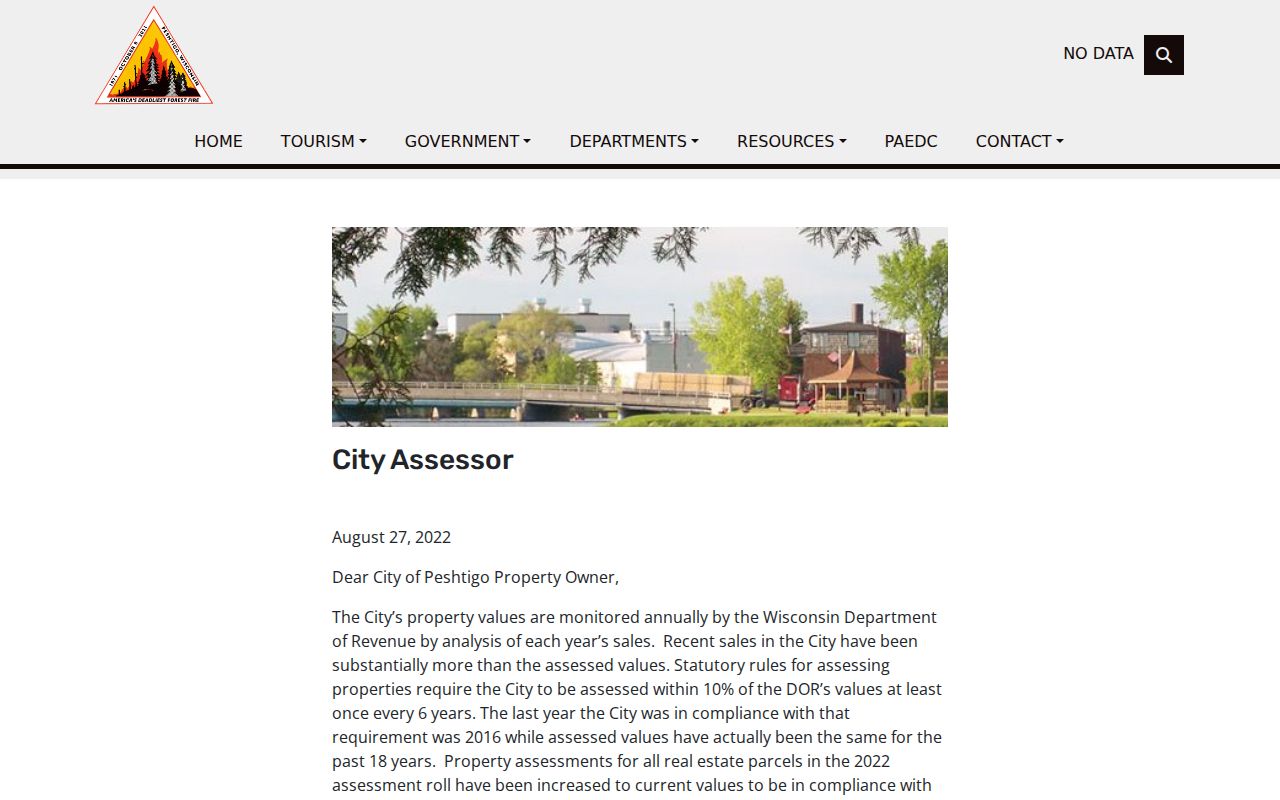
The City Assessor's notice dated August 27, 2022 says Peshtigo had kept assessed values unchanged for 18 years while recent sales ran substantially higher. The 2022 roll was increased to current values under the state's six-year compliance language. The notice explained that the change altered the assessment base rather than raising the total revenue taxing bodies collected; the mill rate would adjust lower. Parcels with recent improvements or new structures could still see a different bill effect.
The city's assessor notice is a dated explanation, not a current assessment result.
The notice explains that Wisconsin DOR reviews municipal assessment levels through sales analysis and that Peshtigo had been in compliance in 2016 before values stayed unchanged for 18 years. The 2022 catch-up was intended to bring the roll closer to current value under a six-year compliance interval. It did not mean that every parcel had sold for its new assessed amount, nor that the city could collect more total tax revenue solely because the assessment base rose. Individual bills could still differ when a parcel had a new building or improvement, so compare the property record and actual bill rather than applying the citywide explanation to one lot.
The City Assessor's 2022 notice supplies the roll context shown here.
Keep the notice's year, and check today's roll.
Peshtigo Property Records Must Keep City and Town Separate
The Town of Peshtigo publishes its own zoning map, permits, and revaluation notices. None of that governs a City parcel. A Peshtigo address proves nothing about which municipality holds the rules. Confirm the civil municipality in Marinette County GIS first. Then match the office to that label.
Edge parcels trip people up. A neighboring lot can use a different assessor, zoning code, or permit route even with the same postal city. So write the municipality next to every parcel number when comparing a block.
For City parcels, use the assessor notice, Building Inspection forms, and the city clerk or inspector. For Town parcels, use the town's separate zoning map, permits, and assessment notices. The town's open-book dates are not city procedures. A mailing address cannot convert one into the other. When the tax district is unclear, resolve the line in county GIS before comparing values or requesting permit files from either municipality.
Peshtigo Property Records and Unverified Subdivision Names
Peshtigo publishes no reliable named subdivision roster. No plat book-and-page list appears either. A street name is not a subdivision. Use the county parcel, recorded plat, certified survey map, or government-survey description that the actual record shows. Resolve the City and Town boundary first.
| Neighborhood / Subdivision | Era | In the Records |
|---|---|---|
| City of Peshtigo boundary | Current civil boundary | Read GIS municipality and tax district before choosing an assessor |
| Recorded plat or lot/block | Varies by recorded instrument | Use Register of Deeds description; a verified city roster was not located |
| Certified survey map / parcel split | Instrument-specific | Follow parent and child parcel numbers in GIS and Ascent |
A record may use a plat or lot-and-block description. Search that language with the parcel number. Skip invented neighborhood labels. A certified survey map can explain why one parcel carries a parent and a successor number, and the Marinette County parcel map guide covers the county map and plat handoff.
Peshtigo's Permit Page Is a Form Library
The city's Building Inspection page is a form library. It is not a searchable address database. Packets cover residential building, additions, decks, plumbing, electric, HVAC, pools, solar panels, fences, siding, roofs, and sheds, plus commercial building, signs, occupancy, demolition, zoning amendments, and conditional-use permits. The zoning map carries a 2019 update date. That is context, not proof of any parcel's current zoning. The Building Inspection page is the official source for the form categories and inspector contact.
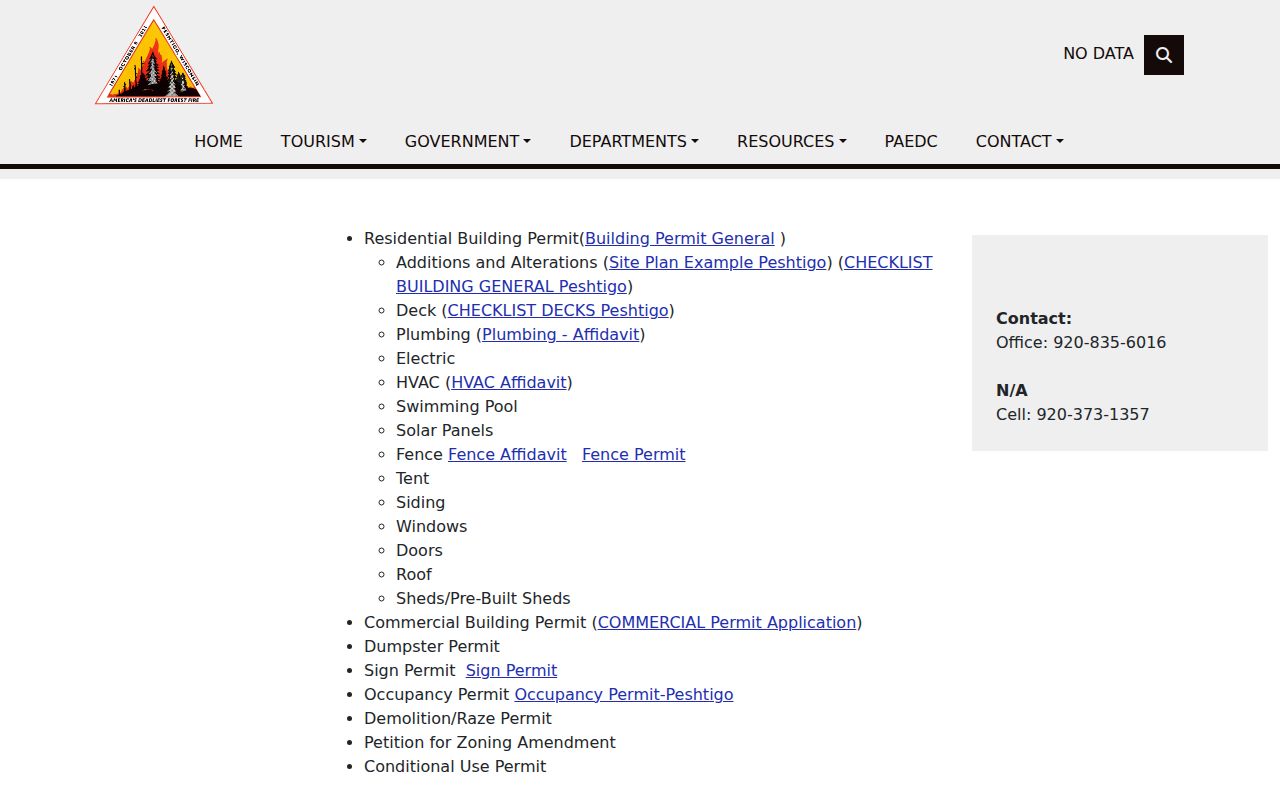
Peshtigo publishes permit applications, not permit outcomes. The page works as a form library. You cannot pull up results for one address there.
Both residential and commercial projects are covered. The city posts forms for decks, plumbing, electric, HVAC, pools, solar panels, fences, siding, roofs, and sheds. Commercial building permits are there too. So are sign, occupancy, and demolition applications. The library also holds zoning amendments and conditional-use requests.
Download the current form before any project starts. Then ask the inspector what applies. Some work needs a building permit, while other jobs trigger zoning approval or an inspection instead. A form only describes the process. It does not prove the city issued anything for a parcel. For confirmed approvals tied to a parcel number, the permit office itself is the stop.
| Request identifiers | Address, parcel number, and legal description |
|---|---|
| Possible file items | Application, project type, permit number, inspection date, and closeout if held |
| Online fields or coverage | No address search fields, historical start year, result cap, or copy fee were located |
Peshtigo Property Tax Bills Route Through County Ascent
Peshtigo's building page works as a form library, not a permit lookup. It lists application types but shows no results for a specific address. That distinction matters for anyone tracing permit history on a parcel.
The forms cover residential and commercial work alike. Categories include decks, plumbing, electric, HVAC, pools, solar panels, fences, siding, roofs, and sheds. Commercial building, signs, occupancy, demolition, zoning amendments, and conditional-use requests round out the list. Each form is a starting point for a project, not evidence of a past approval.
Before any work begins, download the current form and talk with the inspector. Ask whether a project needs a building permit, zoning approval, an inspection, or some other municipal review. The answer depends on the work and the property.
One caution applies to every downloaded application. A blank form shows only which process may exist. It does not prove a permit was filed. It also does not prove one was approved for a particular parcel.
Peshtigo's Fire History Is a Research Lead, Not Parcel Proof
Peshtigo handles property tax bills through the county level. The city's tax-information page sends owners to the Marinette County Treasurer and to Ascent for bills and payment records. Bills go out in mid-December. The first installment, or full payment, is due by January 31. The second installment is due July 31. After January 31, payments belong at the county Treasurer's office, and tax-address changes go there too.
Keep the two record systems straight. The local assessment roll and the county tax account can describe the same property differently. Bring a valuation question to the city's Open Book and Board of Review process. Bring a balance question to the county Treasurer.
Request Peshtigo Permit History From the City Custodian
Peshtigo's past shapes its records, and the city resource page reflects that. It links to Peshtigo Fire information, the fire museum, and local newspaper material. Those sources can help date a building or trace a family. They cannot prove a particular structure burned.
General fire history stays general until a document ties it down. Connect a historical story to a specific parcel only when an official record, deed, permit, or identified address supports the link.
Older land descriptions raise a separate challenge. The current parcel grid did not always exist in its present form. Marinette County deed books begin in 1879, and LandShark's online index reaches back to 1990. The city's resources complement that county record trail. They never replace a recorded conveyance.
What Peshtigo Property Records Show and Their Limits
Peshtigo property records carry real weight, but only so far. An assessment, a tax account, a mapped parcel, a recorded deed, and local permit paperwork are all there to find. What they cannot do is settle everything. They cannot merge the City and Town into one jurisdiction. They cannot prove what a property sold for, show who lives in a building, or settle a boundary dispute. Check which civil municipality holds the parcel. Then confirm anything important with the office keeping the source record.
Lawful use. Use Peshtigo records for property research, transaction review, and civic questions. Do not use owner details to stalk, threaten, or harass anyone; a record search is not a title search.