
Marinette County Deed Records and What They Show
Recording a deed puts the conveyance into the official land-record collection. It also gives public notice of the claimed transfer. The Marinette County Register of Deeds handles warranty, quitclaim, personal-representative, executor, and trustee deeds among its common instruments. A label tells you the form, not the story. The deed type alone will not show whether prior claims were cleared, whether the transfer was an open-market sale, or who actually occupies the parcel. So treat it as one clue among several in the county property records.
| Deed Type | What It Does | Common Use |
|---|---|---|
| Warranty deed | Conveys the interest described and includes the deed's stated assurances | Ordinary conveyance where the parties use that form |
| Quitclaim deed | Transfers whatever interest the grantor holds, if any | Family, estate, or title-cleanup transfer |
| Personal-representative deed | Conveys land through an estate representative | Probate or estate administration |
| Trustee deed | Conveys property through a trustee acting under authority | Trust administration or another authorized transfer |
| Other recorded instruments | May change, burden, release, or describe an interest | Mortgages, satisfactions, easements, liens, plats, and annexations |
Each instrument in the deed records answers a different question. A deed records the conveyance itself. A mortgage records a secured loan. A satisfaction or release records that a prior claim was paid off. Easements and rights-of-way can shape access, and recorded covenants can restrict use of the land. Review the surrounding entries instead of stopping at the first deed. Don't stop at a matching name alone.
Marinette County Deed Records: LandShark Coverage Starts in 1990
The Register of Deeds states that every county real-estate document recorded since Marinette County was organized in 1879 is stored. It is open for public view. The LandShark online index covers 1990 forward. That leaves two routes: a web index for recent decades. Office-held books and indexes cover anything older. A missing online hit before 1990 is expected, not evidence the instrument went unrecorded.
Index access is free after registration. Images and copies run through an account and escrow arrangement. The gateway states that Marinette County offers no credit-card accounts. The county's LandShark coverage page lays out the access options in full.
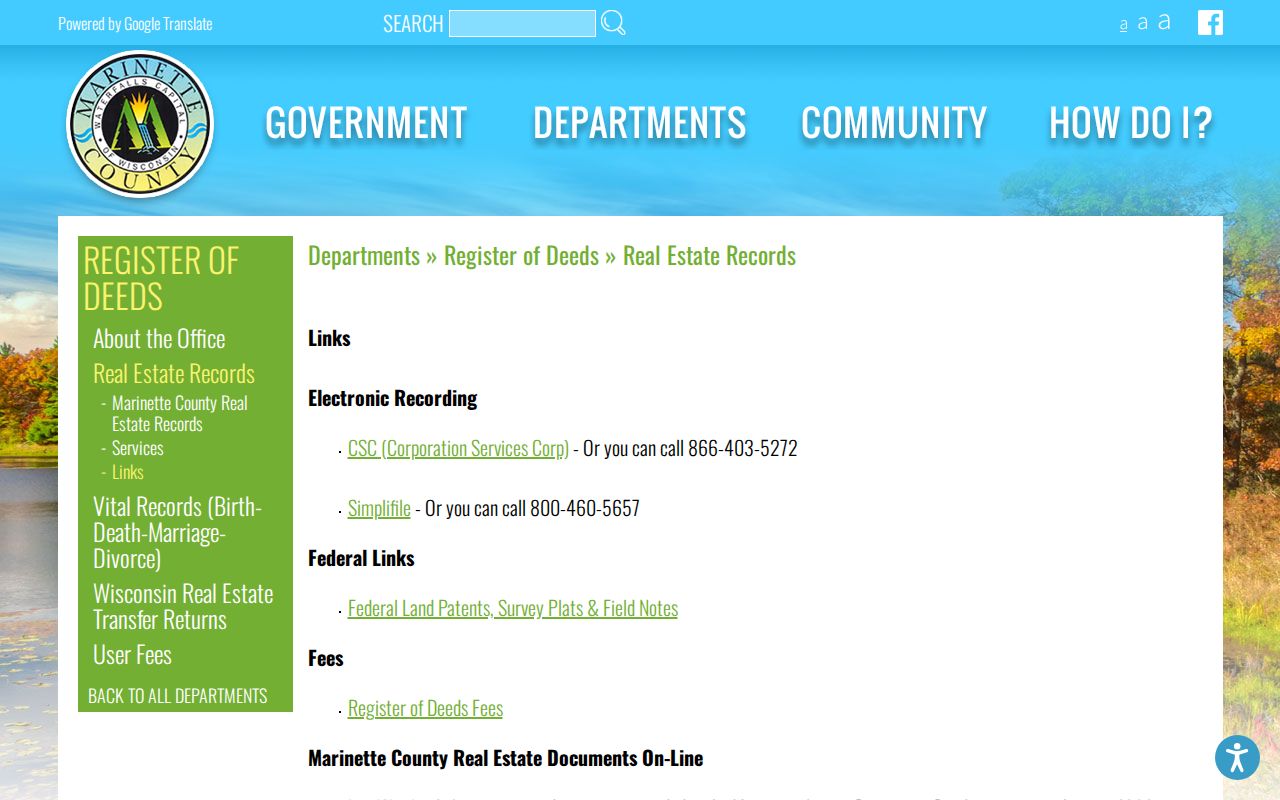
The screenshot describes the coverage boundary and access route, not a sample deed result.
Trace Marinette County Deed Records in the Grantor-Grantee Index
LandShark's public gateway displays its results dynamically. The reliable approach is to start from a known party and match the instrument details returned in the live index. A name alone can be ambiguous. Keep the document date and the legal description in view throughout the deed search. A chain is not complete until you check related mortgages, satisfactions, easements, and probate transfers around the transfer. Those records close the gaps.
- Use the tax parcel or current deed to identify the current grantee and legal description.
- Find that grantee in LandShark and record the matching instrument date and reference.
- Read the grantor names, then search each prior party as a grantee in an earlier instrument.
- Match the same land description and continue through the online index or older deed books.
- Grantor
- The party named as transferring an interest.
- Grantee
- The party named as receiving that interest.
- Chain of title
- The ordered sequence of conveyances tied to the same land.
- Book, page, or document reference
- The locator used by the custodian; copy the format shown in the record.
Recorded Instruments Reach Beyond Conveyances
The Register of Deeds collection reaches well past conveyances. Mortgages, assignments, satisfactions, lien releases, judgments, easements, rights-of-way, and restrictive covenants all sit in the index. So do certified survey maps, subdivision plats, condominium instruments, annexation and plat-vacation records, transfer-on-death instruments, and Wisconsin Real Estate Transfer Returns. A search for one deed may surface a separate document. It may explain a lien, an access route, a lot change, or an estate transfer. The Register of Deeds publishes no complete list of LandShark document categories in text. Confirm the available types in the live system or ask the office. The Register remains the custodian for copies and open-records requests.
For a mortgage review, trace any assignment and hunt for a later satisfaction or release. A lender transfer alone does not prove the obligation was discharged. Some UCC and fixture filings live with the Wisconsin Department of Financial Institutions rather than the county land-record index. A court docket may flag a dispute, but it will not show on its own that a judgment attached to this parcel. Match every entry to the land description and ask the right custodian to confirm its status.
A chain-of-title search works only when each step ties back to the same land. Record the grantor and grantee names, the instrument type, the recording date, the document reference, and the full legal description. A matching party name with a different parcel may belong to another property. After following a deed backward, sweep the intervening years for mortgages, assignments, satisfactions, easements, and liens. Finding the transfer alone does not prove every related claim was released.
Names can be indexed in a representative capacity as well as an individual one. Search the exact wording shown in a deed or tax record, then consider spouse, trustee, estate, or personal-representative names when the instrument suggests them. LandShark's text gateway does not display a confirmed set of search controls. Do not count on a parcel-number field or a particular document-type filter. If the live index returns nothing for an entry you expect, give the Register the recording year and land description. Let the office search its books.
Older Deed Books Require an In-Person Research Route
Marinette County deed research takes a different path before 1990. Real-estate records here reach back to 1879. For that older span, contact the Register of Deeds or use the genealogy counter. Sign-in, limited research space, and careful handling of delicate volumes are part of the routine. Pens, cameras, and cell phones are off limits with the old books. Before traveling, ask which index or book series covers the approximate recording year. The county real-estate records page states the coverage period.
Street names shift over time. A Riverside Avenue lot was once on Main Street. It became River Street by 1887. The Riverside Avenue name arrived by 1895. Search the older names alongside the current address. A lot and block reference or legal description bridges those changes better than a modern street query.
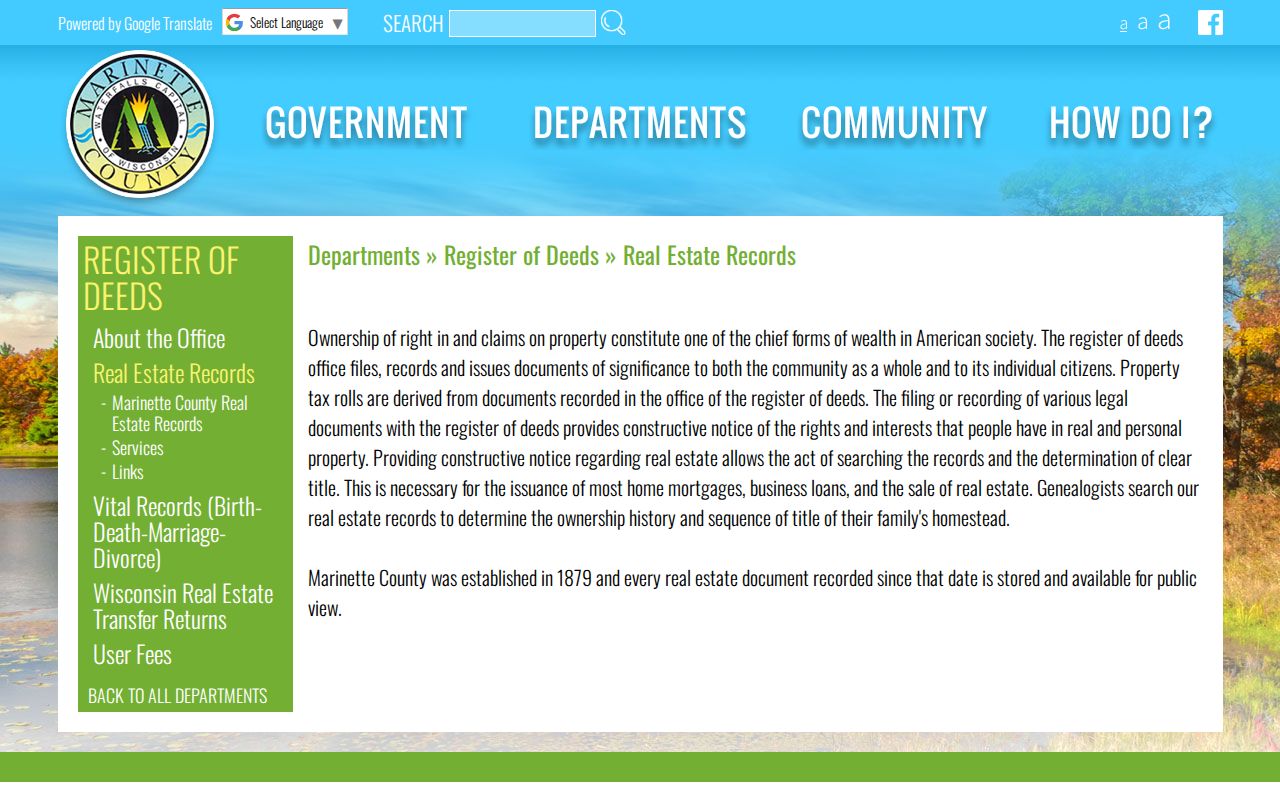
LandShark covers only the more recent indexed period. The county's local page points to a much longer paper history. So an empty result before 1990 reflects a coverage limit. It is not proof that Marinette County holds no deed for the parcel. Visit the Register's public research counter at 1926 Hall Avenue; packages go to 1925 Ella Court. Hours run Monday through Friday, 8:00 a.m. to 4:30 p.m. Call 715-732-7551 first to learn which grantor-grantee index or volume matches your recording period. For a historic street, give staff the modern and earlier names. Add the lot or survey description too.
Check the Copy Route Before Requesting an Instrument
LandShark splits its free index from image retrieval. Getting copies requires an escrow account. The exact balance and user terms vary by account type. The county's general user-fee page lists no numeric real-estate-copy schedule. So do not assume a fixed per-page amount. Check the current Register of Deeds fee page or call before sending payment.
A written request moves faster with the right details. Include the parcel number, current or former site address, and legal description. Add the grantor or grantee, instrument type, approximate recording year, and any document reference you have. Say whether an ordinary or certified copy is needed and how it should be returned. The office takes counter, phone, and mail inquiries.
Wisconsin Public Records Law usually permits an oral request. Another law or a security concern can require writing. A custodian can locate an existing instrument. But the custodian need not build a new report combining deed, tax, and map databases. Keep the request narrow and name the record sought. Ask staff which copy format and current charge apply. When the index is unclear, provide the parties and land description together rather than a surname alone.
Marinette County Deed Records and Transfer Consideration
A Wisconsin Real Estate Transfer Return can add transfer consideration context. The number on a deed transfer may reflect an estate, family change, trust, or other non-arm's-length event. Treat it as context, not a guaranteed market price. The recorded instrument, the tax roll, and the transfer date each answer different questions. Compare all three before drawing conclusions about value.
When a court or estate enters the history, WCCA public case information may explain who had authority to transfer the land. Probate records may help too. The documents themselves generally require review through the proper custodian. For tracing the backward chain and earlier owners of record, see the former-owner record guide.
Getting a Copy of a Marinette County Deed
Start in the online index if the recording date falls within LandShark's coverage. For an image, follow the current account and escrow instructions. Older instruments or an inconclusive index call for a question to office staff. Ask about the right book, index, or counter service. The county publishes no verified universal copy amount. Consult its current fee page for the charge that applies.
Recorded, not guaranteed. Marinette County deed records show filed instruments, but they do not by themselves prove clear title or reveal every unrecorded claim. A title professional reviews the chain and related encumbrances before a transaction.